Although the focus of this paper is Skopje’s political efficiency, in order for the untrained reader to comprehend the issue, one must have a general idea about the formation of a nation’s national security policy. Below, I am attempting to offer in very general and rudimental terms enough information regarding a country’s national security, as I have deemed necessary to establish a reasonable background. Oftentimes this paper refers implicitly or explicitly to war. Such references are intentional, because politics and war, although they differ in means of delivery, they aim at identical objectives, i.e.the imposition of one’s will over another. Thus, when one reads a text that in one’s mind it is associated with war, one should convert one’s thoughts as if the subject refers to politics.
|
0 Comments
Alessandro Basileus Nella Documentazione Epigrafica: La Dedica Del Tempio Di Atena A Priene8/1/2013 La datazione al 334 della dedica di Alessandro iscritta sull’anta del tempio di Atena di Priene appare oggi tutt’altro che assodata. La rilettura delle fasi costruttive dell’edificio alla luce di I.Priene 3 fa escludere che nel 334 questo fosse edificato fino all’anta e pronto per essere dedicato dal Macedone in occasione del suo passaggio dalla Ionia. Una riconsiderazione dei rapportidi Alessandro con le città greche d’Asia rende storicamente poco plausibile che all’inizio dellaspedizione egli usasse ufficialmente nei confronti di poleis, che aveva inteso‚ liberare‘ dal dominio persiano, un titolo quale quello di basileus attestato dall’epigrafe, riecheggiante ancora il dispotismo del Gran Re.
 Depiction of Mansa Musa, ruler of the Mali Empire in the 14th century There is evidence, argues Adrian Tronson, to suggest that the thirteenth-century Mali empire, and its ruler Sundiata, were strongly influenced by the life of Alexander the Great, 356-323 BC, an influence that was to be capitalised on in the late 1950s.
Accounts of the life of Alexander the Great exist in the literary and oral traditions of societies as far afield as Iceland, Ethiopia and Indonesia: this is well known. However, Alexander's 'afterlife' in the oral traditions of the Mandirika peoples of Senegal, Guinea, Mali and the Ivory Coast should be recognised, since it may be said to have influenced to some degree the political destiny of that region. The “principles of democracy, individual liberty and the rule of law” are man’s natural and inalienable rights upon which healthy societies are built. An Alliance such as NATO, being a voluntary organization, requires from its candidates and its active members that they guarantee the protection of values of human decency in individuals. NATO is, in other words, a society of free-states consisting of tolerant citizens, who live in harmony with their neighbors with whom they wish to ally.
Whether one regards NATO as North America’s and Europe’s encroaching hand or whether one conceptualizes the Alliance as the ready policeman of the world, NATO considers itself as the instrument of stability and well-being of the North Atlantic area “founded on the principles of democracy, individual liberty, and the rule of law.” Upon the fall of the Wall in 1989, NATO hastily employed an open door policy, inviting and admitting former Warsaw Pact country members that militarily qualified to join, but lacked democratic values and principles, the absence of which contravene NATO’s own values. In other occasions, the Alliance invited quasi-qualified countries with their sole criterion being their strategic geopolitical location vis-à-vis Russia. The FYROM’s candidacy to NATO is not only problematic, but also pointless. The FYROM does not meet any of the Preconditions set by NATO and save the exception of some troops that the FYROM sent to ISAF, it does not meet any other NATO requirements including a less than medium rated strategic location. The Greek Army entered Thessaloniki in the early hours of Saturday, October 27, 1912 (Old Style). In a moving editorial, the newspaper Makedonia of Thessaloniki in its Sunday, October28, 1912 edition expressed the feelings of the Macedonian Greek as follows:
With warm tears, tears of joy that floods the chest of the slave who recovers his freedom, tears of gratitude that fulfills his existence for his liberator, we salute the Greek army that entered the resplendent city of the Thessalonians. This brilliant trophy of the heroic and victorious Greek Army demolishes the cornerstone of the Turkish state from the Greek Macedonia. Of the state, which, as the kingdoms of ancient monsters were established on layers of bones. Of the state, which has been synonymous to barbarism and horribleness. Of the state, which holding in one hand the torch of arson and in the other the dagger of the murderer, burned and slaughtered our life and our honor, our faith and our ethnicity, and anything holy and sacred that we have. And now the pulverized homeland of Aristotle and Alexander [the Great], whose every hill and every valley, every corner and every span, are soaked in innocent Greek blood and former and recent lamentations of the martyrs of the Faith and Fatherland, throws itself free into the warm and loving arms of Mother Greece. Thus, the great epic of 1821 continues. From the Indus Valley in the east and the Aegean coast in the west, from the Iaxartes/Syr Darya river in the north to the Aswan in the south, the Persian Achaemenid empire, for more than two centuries, was the largest empire ever put together in antiquity. During a decade of conquest, Alexander had constituted it precisely to his advantage by appropriating the same boundaries (Elephantine, Syr Darya, and Indus). Already in antiquity, Greek observers highlighted what they regarded as one of the major problems of imperial government: the contrast between the immensity of imperial territories and the will of the Great Kings to establish and maintain their hold.
Hellenistic Court Society: The Seleukid Imperial Court under Antiochos the Great, 223-187 BCE9/16/2012 During the Hellenistic Age – roughly the last three centuries BCE – the political history of the eastern Ancient World was dominated by three Macedonian dynasties: the Seleukids, ruling a vast empire in the Middle East and Central Asia (312-64 BCE); the Antigonid kings of Macedonia, who tried to control Greece and the Balkans until their kingdom was destroyed by the Romans in 168 BCE; and the Ptolemies (323-30 BCE), who ruled a maritime empire in the eastern Mediterranean from their capital Alexandria, an empire which comprised Egypt but was not therefore an Egyptian empire. In the second century BCE, the Attalid kingdom, based in Pergamon, emerged as the predominant state in the Aegean region, and around 100 Pontos on the Black Sea and Armenia temporarily became major Hellenistic powers.
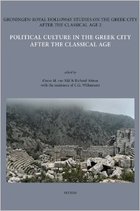
In the transformations of the Classical world from Alexander to the end of the Roman Empire, the politics of the Greek polis underwent crucial changes. Yet, the city retained a vibrant urban political culture. These essays explore that culture and seek to explain the continued importance of city politics in the changing political environments of antiquity. The contributors question long-established interpretative traditions and seek to establish new ways of understanding the politics of the Greek city after the Classical age. (c) 2011 Peeters Publishers | Series: Groningen-Royal Holloway Studies on the Greek City after the Classical Age
This paper examines the organization, numbers and tactics of the Thessalian cavalry unit in the army of Alexander the Great. It is argued that already Philip II recognized the importance of Thessaly as a recruiting ground for heavy (noble) cavalry with regard to his planned invasion of Asia, and that it was partly for this reason that Philip closely integrated Thessaly in the Argead imperial system, cultivating personal relations with the Thessalian noble families also as a counterweight to the power of the traditional Macedonian noble cavalry, the hetairoi (Companions). Alexander inherited these arrangements. The Thessalians on their part joined Alexander’s expedition more enthusiastically than other Greeks because of these pre-existing bonds with the Macedonian royal family and because the promise of honor and booty agreed with the heroic mentality of the Thessalian aristocracy.
L’Introduzione Della Leggenda "ΒΑΣΙΛΕΩΣ ΑΛΕΞΑΝΔΡΟΥ" Nella Monetazione Di Alessandro Magno12/31/2011 Con la scoperta di nuovi documenti epigrafici, la riscoperta o la revisione critica di documenti già noti, il problema della titolatura regale macedone è divenuto negli ultimi anni oggetto di rinnovato interesse, generando un dibattito che è giunto ad assumere i toni di una querelle.
|
Research & DocumentsFind hundreds of research documents for Greece's historic Macedonia region. Categories
All
|
 RSS Feed
